Architecture
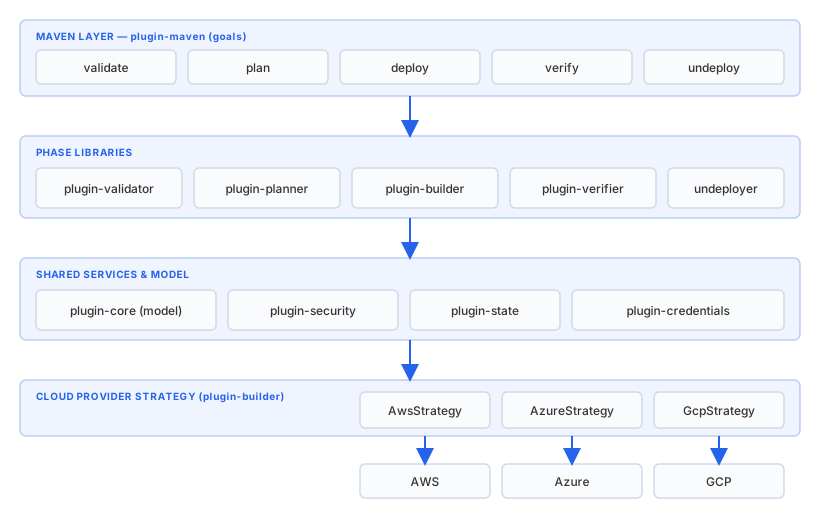
The Serverless Maven Plugin is a multi-module Maven project. A thin set of Maven Mojos drives a five-phase lifecycle (validate → plan → deploy → verify → undeploy) over a shared, immutable domain model. Each phase is implemented by a dedicated library module, and a cloud-provider strategy abstracts the actual AWS / Azure / GCP calls behind a single interface.
This section documents how the plugin is structured internally — the modules and how they depend on one another, the end-to-end deploy pipeline, and the cross-cutting concerns (state, credentials, multi-cloud). For how to use the plugin, see the Getting Started and Configuration Reference pages.
In This Section
The Big Picture
A single mvn serverless:deploy invocation flows top to bottom through the layers below. The Maven layer orchestrates; the phase libraries do the work; the domain model is the common currency passed between them.
Key Design Ideas
- Sealed domain model. Every component is a record implementing the sealed Component interface, so parsing, validation, planning, deployment, and teardown all pattern-match over the same closed set of types.
- Phase cascade. Running any goal automatically runs the phases it depends on first (deploy runs validate then plan), halting the build on the first failure.
- Declarative diffing. The planner compares desired configuration against live cloud state (and a persisted state manifest) to compute a change plan of create / update / delete / unchanged.
- Derived least-privilege permissions. Links between components are translated into narrowly-scoped IAM/RBAC grants — wildcards are rejected.
- Provider strategy. A single CloudProviderStrategy.deploy(...) entry point hides all provider-specific SDK work behind the sealed component model.
Continue with Modules & Dependencies →